
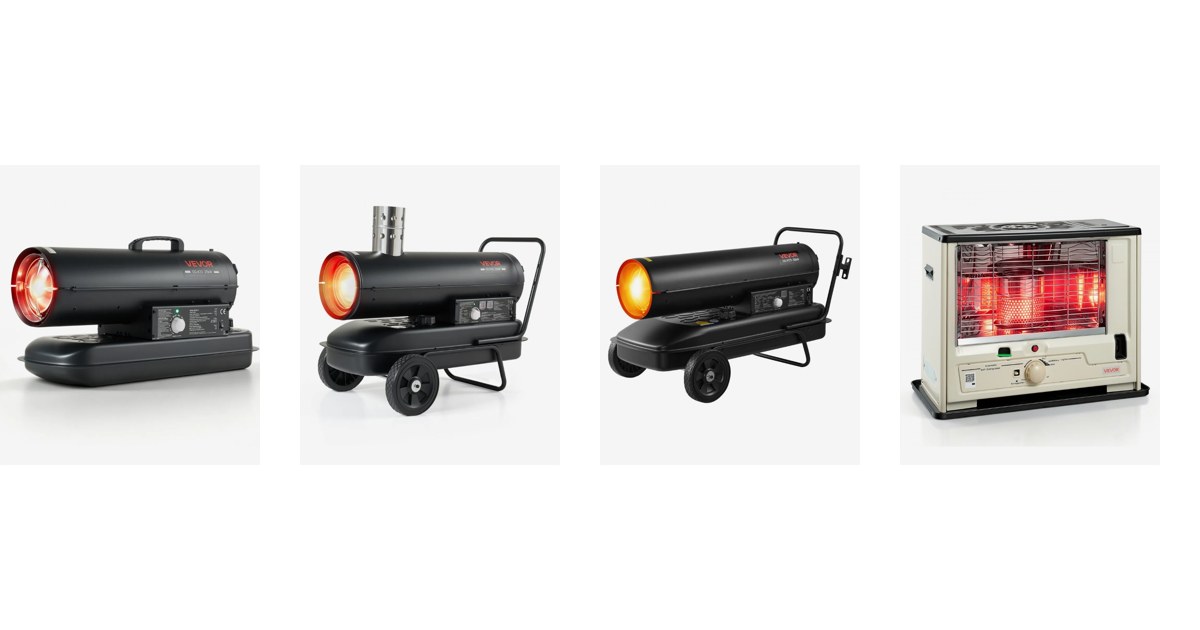
Affiliate disclosure: this post contains affiliate links to VEVOR’s European store (via Awin). If you buy through them, SiftGuide may earn a commission at no extra cost to you. Every price and spec below comes from VEVOR’s own product pages, spec lists, product Q&A answers signed “By vevor”, review summaries and store policies, checked on October 30, 2026. We have not tested these heaters; specs and claims are as listed by the seller. Figures marked “our arithmetic” are our own calculations from those listed numbers.
EU store, euro prices. All links go to eur.vevor.com, VEVOR’s European store. Prices are in euros, VAT included, exactly as the store showed them on October 30, 2026, with Ireland as the delivery country (the store’s default for us). None of the eight prices was a timed deal. Seven pages showed free shipping; the 30 kW indirect-fired heater showed a 10,00 € shipping fee to Ireland. All eight showed delivery between Mon. Nov. 2 and Sat. Nov. 7. Each page also advertised 5,00 € off orders of 99,00 € or more on your first three app orders. Prices and shipping can differ for your country and can change at any time.
A kerosene heater makes heat where there is no gas line and not enough electricity: a garage, workshop, barn, building site or a power cut at home. VEVOR’s EU store sells two very different kinds. Torpedo (forced-air) heaters from 20 kW to 50 kW burn kerosene or diesel and blow hot air with a mains-powered fan. Radiant heaters around 9,000–10,000 BTU burn kerosene on a wick and glow, with no fan and no plug. We went through the 8 listings that were in stock on October 30, 2026, from 76,90 € to 437,99 €; a 100,000 BTU torpedo was out of stock. The questions that matter are direct-fired or indirect-fired, how much fuel per hour, and where the exhaust goes.
Safety first. Every flame heater that is not connected to a flue puts its combustion gases into the room, including carbon monoxide (CO), which you cannot see or smell. Use one only with fresh-air ventilation, keep a working CO alarm in the room, never run one while you sleep, keep it away from anything that can catch fire, and refuel only when it is off and cool, outdoors if you can. VEVOR’s own answers say the same thing in their words: a torpedo heater should be used “in a well-ventilated place” that is “not airtight”, and kerosene burned in a closed room produces carbon dioxide, water vapour and, with poor ventilation, dangerous carbon monoxide. Rules on indoor use of unvented heaters differ between countries; check yours.
- The 8 listings at a glance
- Torpedo or radiant
- Direct-fired vs indirect-fired
- Fuel use and runtime
- Read the listing twice
- Who each one is for
- Shipping, returns and warranty
- FAQ
The 8 VEVOR kerosene and diesel heaters at a glance
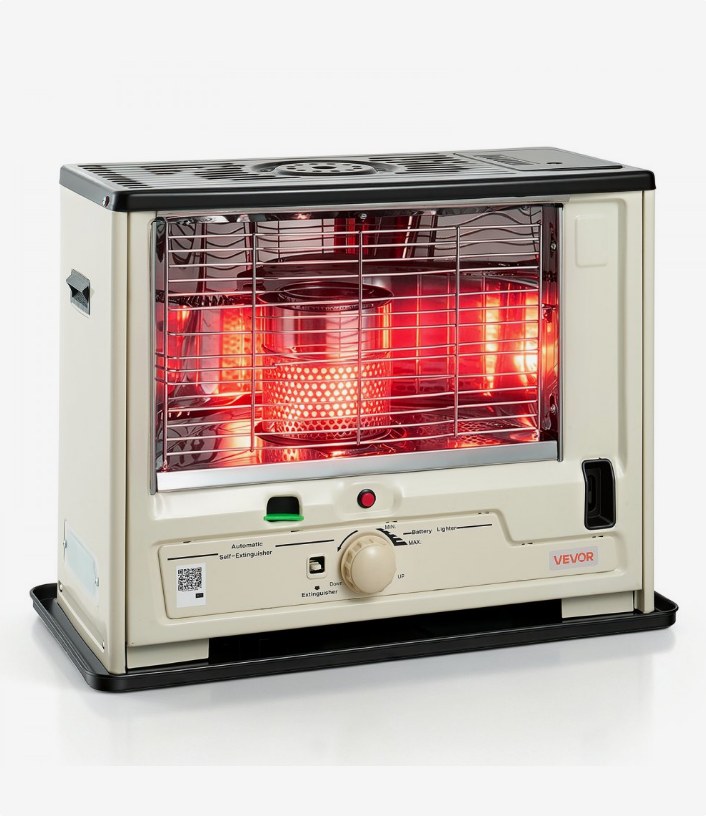
Heater: R95-BMB 9,000 BTU radiant heater/stove
- Price (EU store): 76,90 €
- Type: Radiant, wick
- Fuel: Kerosene
- Tank and use: 5 L (feature text)
- Power: Not on mains
- Net weight: 4.15 kg
Heater: S85-E1 10,000 BTU cordless radiant
- Price (EU store): 189,99 €
- Type: Radiant, wick
- Fuel: Kerosene
- Tank and use: 4.44 L, 0.35 L/h
- Power: 4×AA (ignition)
- Net weight: 11.95 kg
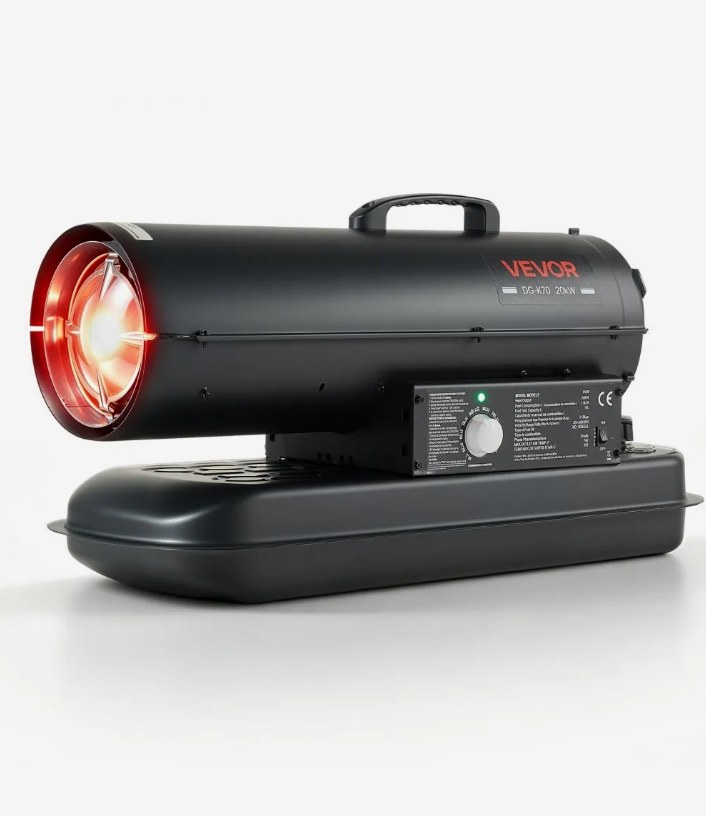
Heater: DG-K70 20 kW torpedo, carry handle
- Price (EU store): 194,99 €
- Type: Direct-fired
- Fuel: Kerosene / diesel
- Tank and use: 19 L, 1.9 L/h
- Power: 220 V mains
- Net weight: 12.6 kg
Heater: DG-K70 70,000 BTU torpedo (older listing)
- Price (EU store): 214,90 €
- Type: Direct-fired
- Fuel: Kerosene / diesel
- Tank and use: 19 L, 1.9 L/h
- Power: 220–240 V mains
- Net weight: 14.8 kg
Heater: DG-K100 30 kW torpedo on wheels
- Price (EU store): 266,99 €
- Type: Direct-fired
- Fuel: Kerosene / diesel
- Tank and use: 38 L, 2.9 L/h
- Power: 220 V mains
- Net weight: 19 kg
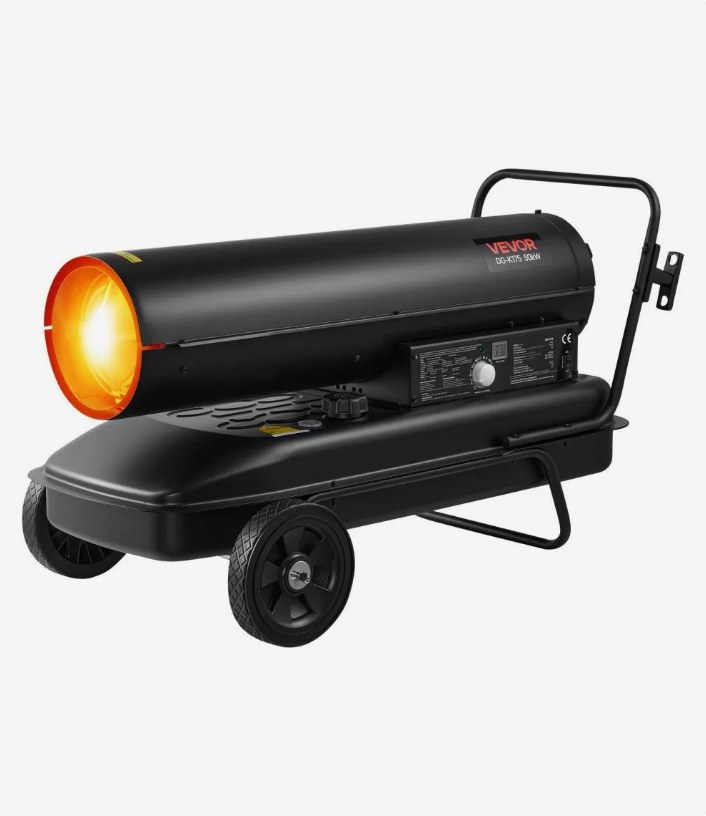
Heater: DG-K175 50 kW forced air, 190 L tank
- Price (EU store): 294,90 €
- Type: Direct-fired
- Fuel: Diesel or kerosene
- Tank and use: 190 L, see below
- Power: 230 V mains
- Net weight: 22.3 kg
Heater: DG-H70 20 kW indirect-fired
- Price (EU store): 319,99 €
- Type: Indirect, chimney
- Fuel: Kerosene / diesel
- Tank and use: 38 L, 1.9 L/h
- Power: 220 V mains
- Net weight: 23.7 kg
Heater: 30 kW indirect-fired
- Price (EU store): 437,99 € + 10,00 € shipping
- Type: Indirect, chimney
- Fuel: Kerosene / diesel
- Tank and use: 50 L, 2.9 L/h
- Power: 220 V mains
- Net weight: 28.1 kg
Review scores are pooled. All six torpedo pages show the same 4.5 out of 5 from 210 reviews (78% 5-star, 6% 1-star), and the reviews shown on the 30 kW and 50 kW pages include ones tagged “Heating Capacity: 20 kW, Combustion Type: Indirect Fired”. So that score cannot tell you which torpedo is better. The R95-BMB radiant heater has its own 4.4 from 31 reviews; the S85-E1 has a single review, of 1 star.
Torpedo or radiant
Torpedo (forced-air) heaters are what you see on building sites: a burner in a steel tube, a fan behind it and a fuel tank underneath. They heat a large, draughty space fast. Every VEVOR torpedo here runs on mains power for the fan, ignition and thermostat; VEVOR says the DG-K70 uses “0.3 kWh per hour” of electricity, about 3 kWh over a 10-hour tank (our arithmetic). They are loud: VEVOR’s own answer on the DG-K70 calls the noise an “industrial sound” that “is normal”.
Radiant heaters burn kerosene on a wick behind a grill, so they are quiet and need no socket. They warm people and objects near them rather than a whole hangar. 9,000 BTU is about 2.6 kW and 10,000 BTU about 2.9 kW (our arithmetic), similar to a large electric fan heater. Neither radiant model here has a flue: VEVOR describes the S85-E1 as a “ventless/unvented portable unit” that “does not require an exhaust pipe”, which also means all its exhaust stays in the room. The “three chimney options” listed for it are interchangeable chimney styles on the heater, not a flue to the outside.
Direct-fired vs indirect-fired
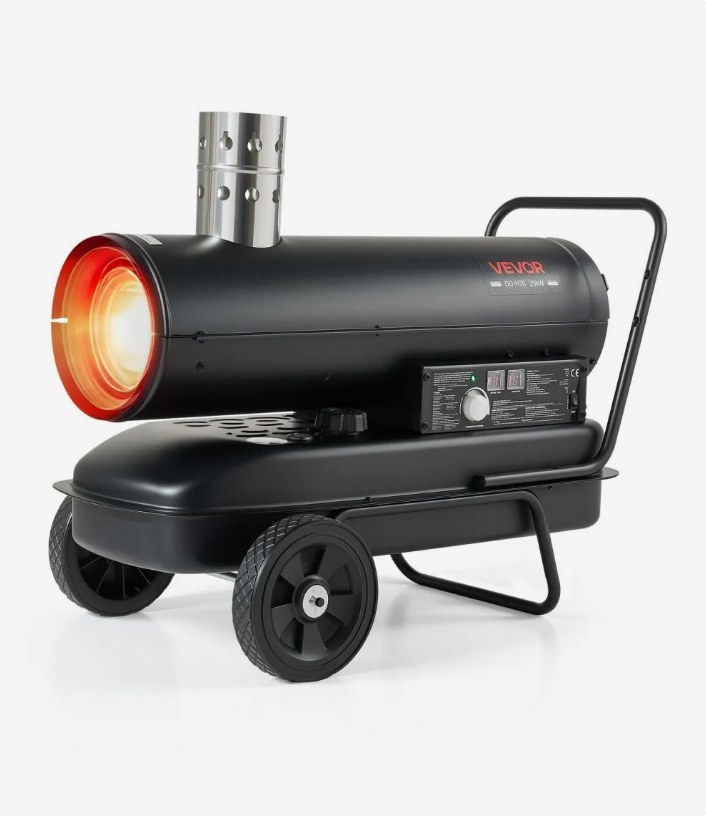
This is the biggest choice among the torpedoes. A direct-fired heater blows the flame’s hot gases straight into the space: all the fuel’s heat reaches you, and so does all the exhaust. An indirect-fired heater burns inside a heat exchanger; the fan blows clean air over it, and the exhaust leaves through the chimney on top, which you can duct outside. That is what you want where people work for hours in a closed space, or where fumes would spoil paint, plants or stock.
On VEVOR’s pages, indirect costs more and heats less (our arithmetic):
Size: 20 kW
- Direct-fired: DG-K70, 194,99 €
- Indirect-fired: DG-H70, 319,99 €
- Extra for indirect: 125,00 €
- Area listed: 160 m² direct vs 128 m² indirect
Size: 30 kW
- Direct-fired: DG-K100, 266,99 €
- Indirect-fired: no model no., 437,99 € + 10,00 € shipping
- Extra for indirect: 171,00 € plus shipping
- Area listed: 240 m² direct vs 192 m² indirect
The indirect units are also heavier and bulkier: 23.7 kg and 28.1 kg against 12.6 kg and 19 kg for the direct ones, both indirect models on wheels with a carry handle. One buyer in Sweden wrote that the chimney of their 20 kW indirect “was damaged in shipping” and that VEVOR shipped a new one “within a few days”. Neither page lists the chimney’s diameter in the spec table, so measure your flue pipe against the heater once it arrives, or ask VEVOR before ordering ducting.
Fuel use and runtime
A litre of kerosene or diesel holds roughly 10 kWh of heat (an approximate figure; our arithmetic uses it). So a 20 kW heater should burn about 2 L an hour at full output, and VEVOR’s 1.9 L/h for its 20 kW models and 2.9 L/h for its 30 kW models fit that. Runtime is simply tank divided by use (our arithmetic):
Heater: 20 kW direct DG-K70
- Tank: 19 L
- Use: 1.9 L/h
- Tank ÷ use: 10 h
- Runtime listed: up to 10 h
Heater: 70,000 BTU DG-K70
- Tank: 19 L
- Use: 1.9 L/h
- Tank ÷ use: 10 h
- Runtime listed: 9.5 h
Heater: 30 kW direct DG-K100
- Tank: 38 L
- Use: 2.9 L/h
- Tank ÷ use: 13.1 h
- Runtime listed: up to 13 h
Heater: 20 kW indirect DG-H70
- Tank: 38 L
- Use: 1.9 L/h
- Tank ÷ use: 20 h
- Runtime listed: up to 20 h
Heater: 30 kW indirect
- Tank: 50 L
- Use: 2.9 L/h
- Tank ÷ use: 17.2 h
- Runtime listed: up to 17 h
Heater: S85-E1 radiant
- Tank: 4.44 L
- Use: 0.35 L/h
- Tank ÷ use: 12.7 h
- Runtime listed: up to 12.6 h
Heater: R95-BMB radiant
- Tank: 5 L
- Use: 0.24–0.28 “gallons”/h
- Tank ÷ use: see below
- Runtime listed: up to 20 h
The indirect 20 kW has twice the tank of the direct 20 kW (38 L vs 19 L), so it runs twice as long between refills at the same fuel rate. The torpedoes take kerosene or diesel; VEVOR recommends “1-K kerosene for comfortable operation”, says to use “only one type” of fuel at a time, and lists an automatic shut-off on low fuel. Both radiant heaters are kerosene only.
Read the listing twice
- The 50 kW’s fuel numbers do not add up. The DG-K175 page says its “50-gallon /190L tank delivers up to 10 hours of powerful heating at 4.8 gal per hour”. 4.8 gallons is about 18.2 L an hour, which would be roughly 180 kW of fuel, not 50 kW; a 50 kW burner should use about 5 L an hour, which would make a 190 L tank last about 38 hours, not 10 (our arithmetic). We cannot tell which figure is wrong. Its listed thermostat range, “5℉ – 45℉ / -15℃ – 7.2℃”, is also clearly not right for a heater, and one feature line calls it a “radiant” heater although it is a forced-air unit. Ask VEVOR before you buy it for its runtime. VEVOR also writes that it is “designed for professional settings” and “not for infrequent household use”.
- The R95-BMB’s tank. The feature text says “1.3 Gal / 5L”; the spec table says “5 Gal / 19 L”. 5 L over 20 hours is 0.25 L an hour, which matches a 2.6 kW heater and the listed “0.24-0.28” if those are litres, not gallons (our arithmetic). Expect a tank of about 5 L. The same page also calls it a “forced air heater”; the photos show a round wick heater with a cooking top that VEVOR says supports up to 15 kg of pots.
- Two DG-K70 listings. The 20 kW at 194,99 € and the 70,000 BTU at 214,90 € carry the same model number, tank and fuel rate. 70,000 BTU is about 20.5 kW (our arithmetic), so they are the same class of heater, and the newer listing costs 19,91 € less. Asked the difference, VEVOR answered (in Swedish) that the old model had a cart with wheels and the new one a carry handle. The older listing’s page is the one with VEVOR’s detailed answers on fuel, ventilation and electricity use, and lists the 130 °C overheat shut-off.
- Heating areas are optimistic and inconsistent. The S85-E1 (10,000 BTU) lists 10 m², while the R95-BMB (9,000 BTU) is sold for 30 m². The 30 kW indirect has no model number on its spec table, and the S85-E1’s spec label reads “Item Mode Numerl”. Treat every area figure as a rough guide; insulation and draughts matter more.
Who each one is for
- VEVOR DG-K70 20 kW direct-fired (194,99 €): for a draughty garage or site you heat for a few hours, with the door ajar; the cheapest torpedo at 9,75 € per kW (our arithmetic). Skip it if anyone works in the space for long hours with doors shut; pay for indirect.
- VEVOR DG-K100 30 kW direct-fired (266,99 €): for bigger sheds and barns; 72,00 € more than the 20 kW for 50% more heat and twice the tank (our arithmetic). Skip it if you cannot ventilate the space well.
- VEVOR DG-H70 20 kW indirect-fired (319,99 €): for a workshop or garage where you spend the day, with the chimney ducted outside. Skip it if you need the most heat per euro; it costs 125,00 € more than the direct 20 kW.
- VEVOR 30 kW indirect-fired (437,99 €): for larger enclosed spaces where exhaust must go outside; 50 L tank. Skip it if you mind the 10,00 € shipping, 28.1 kg weight and the missing model number.
- VEVOR DG-K175 50 kW (294,90 €): for big open job sites and warehouses where the 190 L tank saves refills. Skip it if you need its runtime confirmed; the listed fuel rate contradicts the 50 kW rating.
- VEVOR DG-K70 70,000 BTU (older listing) (214,90 €): for only if you specifically want this listing. Skip it if you are happy with the same model as the 20 kW for 19,91 € less.
- VEVOR R95-BMB 9,000 BTU radiant (76,90 €): for a quiet, plug-free heater for a power cut, tent awning or garden room with ventilation, and a hob on top; the cheapest at 76,90 €. Skip it if you want to heat a large room or run it unattended.
- VEVOR S85-E1 10,000 BTU cordless radiant (189,99 €): for a living-room-style radiant heater with tip-over and overheat protection and battery ignition. Skip it if one 1-star review and a 10 m² rating at 189,99 € put you off.
Shipping, returns and warranty
- Shipping: VEVOR’s EU shipping policy says “All products are currently free shipping, except in some remote areas”, but lists per-item surcharges for items of 30 kg and above: 10 € for Ireland and Portugal, 30 € for Finland and Croatia, 40 € for Romania, among others. On October 30, 2026 only the 30 kW indirect showed a fee (10,00 € to Ireland). Check the fee for your country in the basket.
- Returns and warranty: “All our products come with a 12-months warranty and can be returned for free within 30 days of delivery for approved reasons!” A heater that has had fuel in it may be harder to send back, so inspect it, and the chimney on indirect models, before the first fill.
Related on SiftGuide
Heating a camper, van or cabin rather than a garage? See our VEVOR diesel heater buying guide for small vented air heaters, the VEVOR 12V tire inflator guide and the VEVOR 12V electric winch guide for the garage, or browse all our picks on the SiftGuide links page. Clearing the drive as well? Our new VEVOR snow pushers & snow plow kits guide compares seven in-stock listings from 39,99 € to 427,99 €: 61–122 cm pushers, a wheeled pusher, a snowblower kit and an ATV plow.
FAQ
Which VEVOR kerosene heater is cheapest?
The R95-BMB 9,000 BTU radiant heater at 76,90 €. The cheapest torpedo is the DG-K70 20 kW direct-fired at 194,99 €. Prices as shown on the EU store on October 30, 2026, VAT included, free shipping to Ireland.
Can I run a kerosene heater indoors?
Only with ventilation and a CO alarm, never while sleeping, and only if your local rules allow it. Direct-fired and wick heaters release all their exhaust into the room; VEVOR itself says to use its torpedo “in a well-ventilated place”. An indirect-fired heater with its chimney ducted outside is the better choice for closed spaces.
Do these heaters need electricity?
The torpedo models do: each lists a 220–240 V mains supply, and VEVOR gives 0.3 kWh per hour for the DG-K70. The radiant R95-BMB needs no power, and the S85-E1 uses 4 AA batteries (included) for ignition.
Can I use diesel instead of kerosene?
The torpedo models list kerosene or diesel; VEVOR recommends 1-K kerosene and says to use only one fuel at a time. Both radiant heaters are listed for kerosene only.
How long does a tank last?
On VEVOR’s figures, about 10 hours for the 20 kW direct, 13 for the 30 kW direct, 20 for the 20 kW indirect and 17 for the 30 kW indirect (our arithmetic). Check the 50 kW with VEVOR: its listed fuel rate does not match its rating.
Sources: VEVOR EU product pages, spec lists, review summaries and Q&A for the R95-BMB 9,000 BTU radiant heater, the S85-E1 10,000 BTU cordless radiant heater, the DG-K70 20 kW and 70,000 BTU torpedo heaters, the DG-K100 30 kW, the DG-K175 50 kW, and the DG-H70 20 kW and 30 kW indirect-fired heaters; VEVOR EU shipping and return policies; all checked on October 30, 2026. Figures marked “our arithmetic” are our own calculations from those numbers, using about 10 kWh per litre of fuel and 1 BTU/h = 0.293 W.