
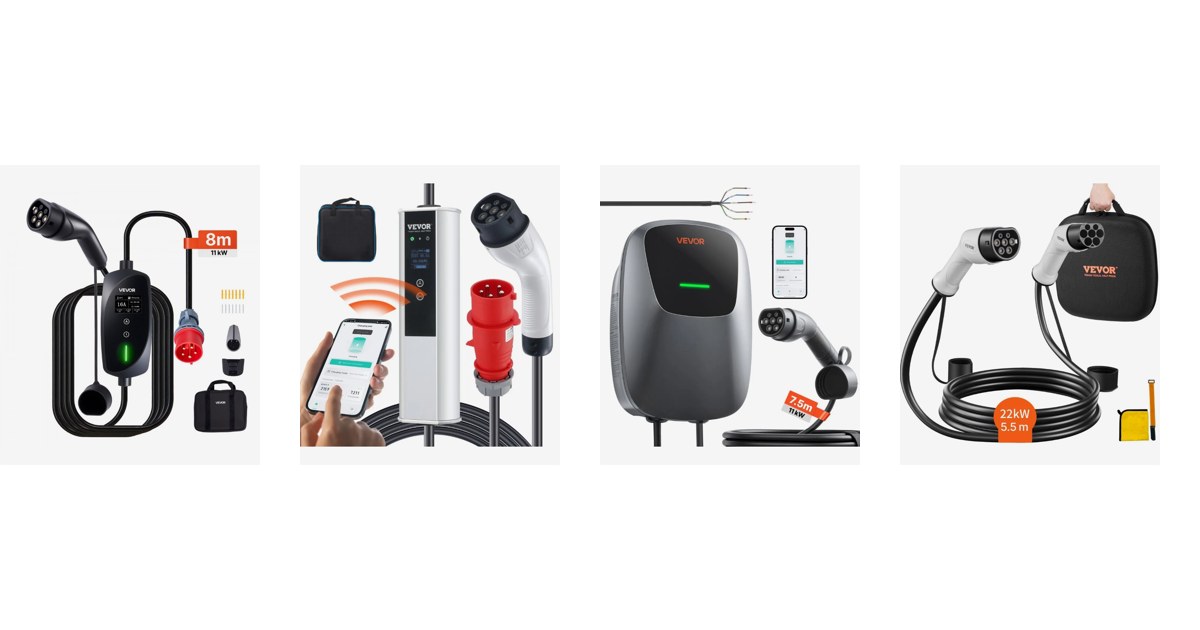
Affiliate disclosure: this post contains affiliate links to VEVOR’s European store (via Awin). If you buy through them, SiftGuide may earn a commission at no extra cost to you. Every price and spec below comes from VEVOR’s own product pages, spec lists, Q&A answers, reviews and store policies, checked on November 2, 2026. We have not tested these products; specs and claims are as listed by the seller. Figures marked “our arithmetic” are our own calculations from those listed numbers. This is a buying guide, not electrical advice.
EU store, euro prices. All links go to eur.vevor.com, VEVOR’s European store. Prices are in euros, VAT included, exactly as the store showed them on November 2, 2026 (captured around 02:30 Romanian time and re-checked just before publishing), with Romania as the delivery country (the store’s default for us that day). Every model we link showed “In Stock” and free shipping, with no deal or countdown price.
If you own an electric car or a plug-in hybrid, the cable that came with it is often the weak point: a slow “granny charger” for a household socket, or no Type 2 cable for public AC posts at all. On November 2, 2026 VEVOR’s EU store had 14 relevant models in stock, from 84,90 € to 343,90 €: seven portable Type 2 chargers (the kind that plug into a socket, including VEVOR’s “Mobile Wallbox” range), two 11 kW smart wallboxes and four Type 2 to Type 2 charging cables for public posts and wallboxes without a tethered cable. We sorted them by the one question that decides everything: what supply you actually have. We also flagged what VEVOR’s own Q&A says about DC fault protection, which matters for the RCD your electrician has to fit.
Safety first. An EV charger draws its full rated current for hours, which ordinary sockets and old wiring are not always built for. Before regular use, have an electrician check the socket, the cable run and the breaker, and fit a dedicated circuit for any CEE 16 or CEE 32 (red “industrial”) socket. On a household Schuko socket, start with the lowest current the charger allows. VEVOR’s own answers say its Mobile Wallbox chargers have no built-in 6 mA DC fault detection, only Type A residual-current protection, so ask your electrician which RCD the circuit needs (for EV charging points without DC fault detection that is usually a Type B RCD). Never run an EV charger through a household extension lead or cable reel. Hardwired wallboxes are an electrician’s job, and in some countries (Germany, for example) a wallbox has to be reported to the grid operator.
- The 14 models at a glance
- Portable charger, wallbox or cable?
- Single-phase vs three-phase: the kW maths
- Portable chargers and Mobile Wallboxes
- DC fault protection: what VEVOR says
- Smart wallboxes
- Type 2 to Type 2 cables
- What we left out (and why)
- Who each one is for
- Shipping, returns and warranty
- FAQ
The 14 VEVOR EV chargers and cables at a glance
Model: Mobile Wallbox 3.6 kW (EV-ACS1602E/K3)
- Type: Portable, single-phase
- Key specs (as listed): Schuko plug, 6–16 A, 6 m, LCD
- Price: 124,90 €
Model: Portable 3.7 kW (EV-B06-EU003A)
- Type: Portable, single-phase
- Key specs (as listed): CEE 7/7 plug, 16 A, 8.6 m, app
- Price: 118,90 €
Model: Portable 3.7 kW LCD (EV-B06-EU003B)
- Type: Portable, single-phase
- Key specs (as listed): CEE 7/7 plug, 16 A, 8.6 m, LCD + app
- Price: 126,90 €
Model: Mobile Wallbox 7.4 kW (EV-ACS3201E/K3)
- Type: Portable, single-phase
- Key specs (as listed): Blue CEE32 plug, 10–32 A, 6 m, LCD
- Price: 141,90 €
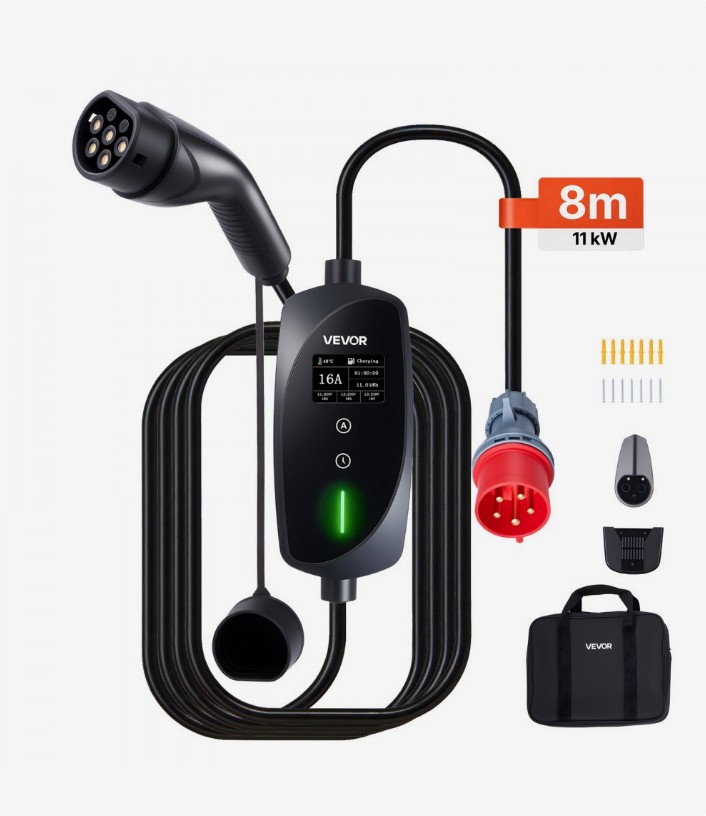
Model: Mobile Wallbox 11 kW (EV-ACS1601PE/K3)
- Type: Portable, three-phase
- Key specs (as listed): CEE 16 plug, 6–16 A, 8 m, LCD
- Price: 187,90 €
Model: Mobile Wallbox 22 kW (EV-ACS3201PE/K3)
- Type: Portable, three-phase
- Key specs (as listed): CEE 32 plug, 10–32 A, 7 m, LCD
- Price: 242,90 €
Model: Portable 11 kW aluminium (EV-B07-EU011B)
- Type: Portable, three-phase
- Key specs (as listed): CEE 16 plug, 8–16 A, 7.5 m, LCD + app
- Price: 250,90 €
Model: Portable 22 kW aluminium (EV-B07-EU022B)
- Type: Portable, three-phase
- Key specs (as listed): CEE 32 plug, 16–32 A, 7.5 m, LCD + app
- Price: 343,90 €
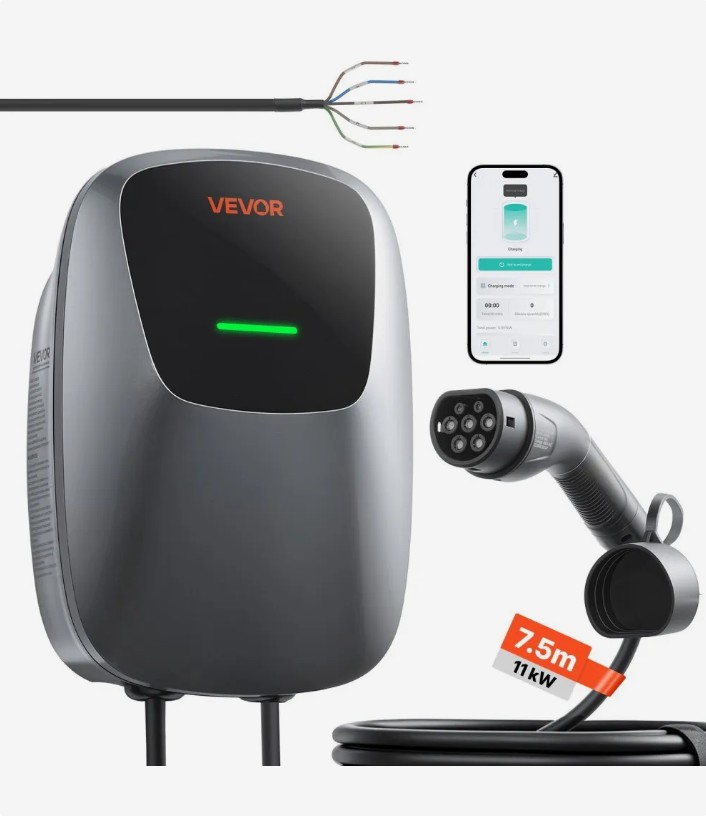
Model: Smart wallbox 11 kW (ZB13, hardwired)
- Type: Wallbox, three-phase
- Key specs (as listed): Hardwired, 16 A, 7.5 m, Wi-Fi app, IP65
- Price: 233,99 €
Model: Smart wallbox 11 kW (ZB13, CEE plug)
- Type: Wallbox, three-phase
- Key specs (as listed): CEE 16 plug, 16 A, 7.5 m, display + app
- Price: 251,99 €
Model: Type 2 cable 7 kW, 5 m
- Type: Cable, single-phase
- Key specs (as listed): 32 A, 2.3 kg, IP66
- Price: 84,90 €
Model: Type 2 cable 11 kW, 5 m
- Type: Cable, three-phase
- Key specs (as listed): 16 A, 2.16 kg, IP66
- Price: 87,90 €
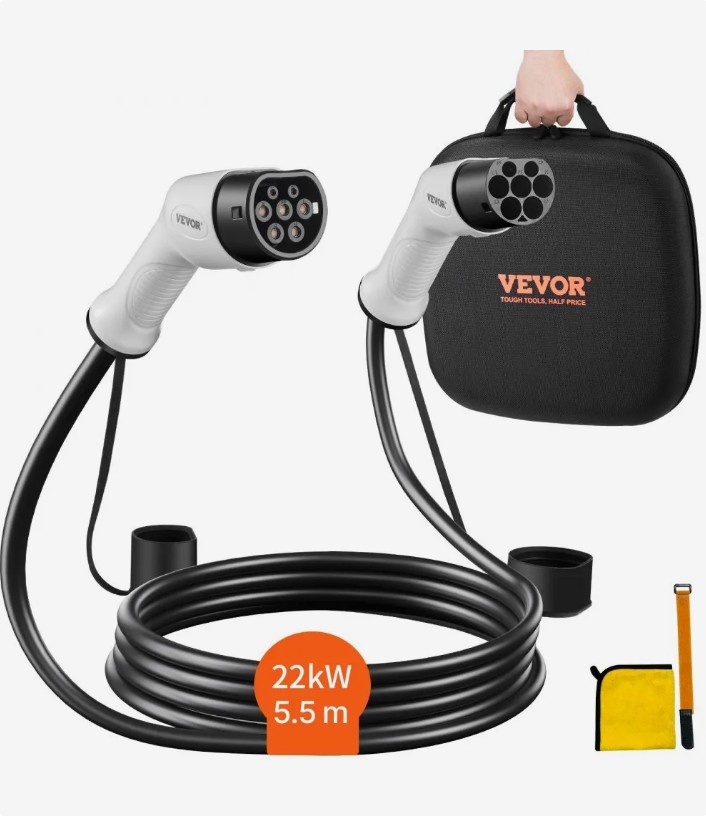
Model: Type 2 cable 22 kW, 5 m
- Type: Cable, three-phase
- Key specs (as listed): 32 A, 3.3 kg, IP66
- Price: 117,90 €
Model: Type 2 cable 22 kW, 7 m
- Type: Cable, three-phase
- Key specs (as listed): 32 A, 4.2 kg, IP66
- Price: 144,90 €
Portable charger, wallbox or cable?
- Portable charger (Mode 2): a control box in the cable, a socket plug on one end and a Type 2 connector for the car on the other. You plug it into a socket at home, at a holiday house or at work. Most VEVOR models here come with a wall holder, so the same unit can live on your garage wall and travel in the boot.
- Wallbox: a fixed charging station with a tethered cable. Neater and normally the safest daily setup, but it needs an installation: the hardwired VEVOR model is wired into your consumer unit by an electrician.
- Type 2 to Type 2 cable (Mode 3): no electronics, just a cable. You need one for public AC posts and wallboxes that only have a socket. It does nothing on a normal household socket.
Single-phase vs three-phase: the kW maths
Charging power is volts × amps × phases. With the 230 V that VEVOR lists per phase: 16 A on one phase is about 3.7 kW, 32 A on one phase about 7.4 kW, 16 A on three phases about 11 kW and 32 A on three phases about 22 kW (our arithmetic: 230 × 16 = 3,680 W; 230 × 32 = 7,360 W; 3 × 230 × 16 = 11,040 W; 3 × 230 × 32 = 22,080 W). That is exactly why the models come in 3.6/3.7, 7.4, 11 and 22 kW.
Supply: Single-phase 16 A (Schuko, CEE 7/7)
- Power: 3.7 kW
- 10–80% of a 60 kWh battery (42 kWh)*: about 11.4 h
- VEVOR’s claim: about 34 km per hour (3.6 kW Mobile Wallbox)
Supply: Single-phase 32 A (blue CEE32)
- Power: 7.4 kW
- 10–80% of a 60 kWh battery (42 kWh)*: about 5.7 h
- VEVOR’s claim: about 70 km per hour
Supply: Three-phase 16 A (red CEE 16)
- Power: 11 kW
- 10–80% of a 60 kWh battery (42 kWh)*: about 3.8 h
- VEVOR’s claim: about 104 km per hour
Supply: Three-phase 32 A (red CEE 32)
- Power: 22 kW
- 10–80% of a 60 kWh battery (42 kWh)*: about 1.9 h
- VEVOR’s claim: about 208 km per hour
*Our arithmetic, energy divided by power, ignoring charging losses and the slow-down near full. The “km per hour” figures are VEVOR’s own claims from the Mobile Wallbox listings.
The catch: your car decides too. Its onboard charger has a maximum AC power, often 11 kW, and some cars charge on a single phase only. A 22 kW charger on a car that takes 11 kW still charges at 11 kW, and a single-phase car on a three-phase charger uses one phase. Check the “AC charging” figure in your car’s manual before paying for 22 kW.
Portable chargers and Mobile Wallboxes
Single-phase (household or blue CEE socket)
- Mobile Wallbox 3.6 kW, Schuko plug (124,90 €): plugs into a normal Schuko socket, adjustable from 6 to 16 A, 6 m cable, LCD with live current and voltage, a 1–12 h delay timer for off-peak tariffs and an IP66 control box. VEVOR says you can mount it permanently on the wall or keep it in the car. A buyer of the 22 kW version titled their review “Good but no app”: the Mobile Wallbox range has the timer on the unit, not on your phone.
- Portable 3.7 kW, CEE 7/7 plug (118,90 €) and the same charger with an LCD (126,90 €): the cheapest charger here, with the longest cable (8.6 m), app control with 1–12 h scheduling, a hard-shell bag and a wall holder. The LCD version is 8,00 € more (our arithmetic). VEVOR confirms it shows a ground fault and will not charge on a socket without earth, which is what you want.
- Mobile Wallbox 7.4 kW, blue CEE32 plug (141,90 €): twice the power of the household-socket models for 17,00 € more than the 3.6 kW one (our arithmetic), adjustable 10–32 A, 6 m cable. It needs a single-phase 32 A CEE socket on its own circuit: an electrician job, but the cheapest route to 7.4 kW in a house without three-phase power.
Three-phase (red CEE 16 or CEE 32 socket)
- Mobile Wallbox 11 kW, CEE 16 plug (187,90 €): our pick for most EV owners with a three-phase supply. 6–16 A adjustable, 8 m TPU cable, LCD, delay timer, IP66. 11 kW is the AC limit of many cars, so you rarely gain from more. A buyer charging an MG4 at 11 kW praised it, adding that they could not pair it with the SmartLife app and think it has no app support.
- Mobile Wallbox 22 kW, CEE 32 plug (242,90 €): 55,00 € more than the 11 kW (our arithmetic) for 10–32 A and a 7 m cable. Only worth it if your car accepts 22 kW AC and you have a 32 A three-phase socket.
- Portable 11 kW aluminium, CEE 16 plug (250,90 €): an aluminium-bodied control box (4.88 kg) with LCD and app, current set in steps of 16/13/10/8 A, 7.5 m cable. It costs 63,00 € more than the 11 kW Mobile Wallbox (our arithmetic); you pay for the app and the metal housing. VEVOR answered that it has no adapter cable to use it on a single-phase Schuko socket.
- Portable 22 kW aluminium, CEE 32 plug (343,90 €): the top model, 7.35 kg, current steps of 16/20/24/32 A in the app, 7.5 m cable. The spec list says 7.36 kW single-phase or 22 kW three-phase, but VEVOR’s answer to a buyer reads: “This product is a three-phase charging product. Please use a three-phase power input instead of a single-phase 220V input.” Treat it as three-phase only. It is also the only model here for which VEVOR claims built-in 6 mA DC leakage protection (next section).

DC fault protection: what VEVOR says
A car’s charger can leak a small DC current when it fails, and a standard Type A RCD may not trip reliably on that. Chargers with built-in 6 mA DC detection handle this themselves; without it, your electrician has to cover it at the consumer unit, usually with a pricier Type B RCD. VEVOR does not state this in the spec lists, so we read its Q&A answers:
- Mobile Wallbox 11 kW (Aug 27, 2026): “this charger does not have integrated 6 mA DC residual-current detection. It is only equipped with Type-A residual-current protection.”
- Mobile Wallbox 7.4 kW (Sep 29, 2026, answer in Portuguese): none of VEVOR’s current portable EV chargers, including this one, has integrated 6 mA DC residual-current protection.
- Portable 22 kW aluminium (Oct 28, 2026, answer in Swedish): it has built-in 6 mA DC leakage protection meeting IEC 62752.
The two answers about portable chargers contradict each other, so plan your circuit as if the charger has no DC detection, unless VEVOR confirms otherwise for your exact model in writing. Budget for the right RCD when you compare prices.
Smart wallboxes
- Smart wallbox 11 kW, hardwired (233,99 €): three-phase 400 V, 16 A, a 7.5 m tethered cable, IP65, rated for −30 to 50 °C, LED status light and a Tuya app over 2.4 GHz Wi-Fi for remote control, scheduling and charging data. Asked whether it can run at 7 kW, VEVOR said you just set the current to 10 A in the app. 46,09 € more than the 11 kW Mobile Wallbox (our arithmetic), plus the electrician.
- Smart wallbox 11 kW, CEE 16 plug (251,99 €): the same wallbox with a digital display (current, voltage, power, energy) and a 5-pin CEE 16 A plug on a lead VEVOR gives as 1000 ± 50 mm, so it plugs into an existing red socket instead of being hardwired. 18,00 € more than the hardwired one (our arithmetic).
Six other VEVOR wallboxes (7 kW single-phase and 22 kW versions) were out of stock, with a restock estimate of 3–4 weeks.
Type 2 to Type 2 cables
All four list IP66, TPU sheathing, silver-plated copper-alloy contacts, more than 10,000 plug cycles, CE and TÜV certification and a storage bag. Buy the cable that matches your car’s AC limit: the cable must be rated for at least what the post and the car can do.
- 7 kW single-phase, 5 m (84,90 €): 32 A on one phase, 2.3 kg. For single-phase cars.
- 11 kW three-phase, 5 m (87,90 €): 16 A on three phases, the lightest at 2.16 kg, only 3,00 € more than the 7 kW one (our arithmetic). The sensible default for an 11 kW car.
- 22 kW three-phase, 5 m (117,90 €) or 7 m (144,90 €): 32 A, thicker 6 mm² cores, 3.3 or 4.2 kg. 30,00 € more than the 11 kW cable; the 7 m version adds 27,00 € (our arithmetic). Only for cars that take 22 kW AC, or if you want a cable that suits any future car.
What we left out (and why)
VEVOR also sells Type 2 extension cables (7 and 10 m, 104,90 €–194,90 €). We did not include them: every extra plug-and-socket joint has to carry the full charging current for hours, and car makers generally advise against extension leads for charging. Asked whether its normal Type 2 cable can be used to extend a wallbox cable, VEVOR itself answered no. If the car does not reach, a longer charging cable or a better parking spot is the safer fix. The US-style NEMA chargers that show up in VEVOR searches do not fit European sockets.
Who each one is for
- Household socket only, cheapest: portable 3.7 kW (118,90 €) or the 3.6 kW Mobile Wallbox (124,90 €) if you want 6–16 A adjustment on the unit.
- Single-phase house, faster: 7.4 kW Mobile Wallbox (141,90 €) with a new CEE32 socket.
- Three-phase house, best value: 11 kW Mobile Wallbox (187,90 €).
- App control and a fixed install: 11 kW smart wallbox (233,99 €).
- Public AC posts: 11 kW Type 2 cable (87,90 €); 22 kW only if your car takes it.
Shipping, returns and warranty
All 14 showed free shipping to Romania, with delivery estimated “as soon as” Nov 7–9. VEVOR’s policy says shipping is free “except in some remote areas” and that all products “come with a 12-months warranty and can be returned for free within 30 days of delivery for approved reasons”. Check your car’s inlet and your socket type before ordering; a wrong plug is the most common reason these come back.
FAQ
Can I charge an EV from a normal household socket?
Yes, with a portable charger such as the VEVOR 3.6/3.7 kW models, which plug into a Schuko or CEE 7/7 socket. Have the socket and circuit checked first, because the charger draws up to 16 A for hours; set a lower current if in doubt.
What is the difference between a Mode 2 charger and a Type 2 cable?
A Mode 2 portable charger has a control box and a socket plug, so it works from a wall socket. A Type 2 to Type 2 cable has no electronics and only works with public AC posts or wallboxes that have a Type 2 socket.
Do I need a 22 kW charger?
Only if your car accepts 22 kW AC and you have a three-phase 32 A supply. Many cars take 11 kW AC at most, so the 11 kW models charge them just as fast.
Do VEVOR portable EV chargers have DC fault protection?
According to VEVOR’s Q&A, the Mobile Wallbox chargers do not have 6 mA DC detection, only Type A residual-current protection; VEVOR claims the 22 kW aluminium portable charger does. Ask an electrician which RCD your circuit needs.
Does the VEVOR Mobile Wallbox have an app?
The listings show an LCD and a 1–12 h delay timer on the unit, and buyers report no app. The EV-B06/EV-B07 portable chargers and the ZB13 wallboxes list app control.
Sources: VEVOR EU product pages, spec lists, Q&A answers and reviews for the models above (EV-ACS1602E/K3, EV-ACS3201E/K3, EV-ACS1601PE/K3, EV-ACS3201PE/K3, EV-B06-EU003A/B, EV-B07-EU011B, EV-B07-EU022B, ZB13-E011KAB-F701/F301, ZL-GGS-221026-02/03/04/05) and for the out-of-stock and extension-cable listings mentioned; VEVOR EU shipping and return policies; all checked on November 2, 2026. Prices in euros, VAT included, as shown with Romania as the delivery country.