
Affiliate disclosure: this post contains affiliate links to VEVOR’s European store (via Awin). If you buy through them, SiftGuide may earn a commission at no extra cost to you. Every price and spec below comes from VEVOR’s own product pages, spec lists, Q&A answers and store policies, checked on November 2, 2026. We have not tested these chargers; specs and claims are as listed by the seller. Figures marked “our arithmetic” are our own calculations from those listed numbers.
EU store, euro prices. All links go to eur.vevor.com, VEVOR’s European store. Prices are in euros, VAT included, exactly as the store showed them on November 2, 2026 (captured around 22:30 Romanian time and re-checked just before publishing), with Romania as the delivery country. Every model we link showed “In Stock” and free shipping, and none was on a time-limited deal that day.
Cold weather is hard on batteries: a car that sits for two weeks in January, a motorbike or boat laid up for the winter, a camper’s leisure battery, the battery behind a gate opener or an electric fence. A charger or a maintainer keeps them alive. On November 2, 2026 we went through VEVOR’s EU charger categories and picked 12 chargers from 30,90 € to 212,99 € in three families: LiFePO4 (lithium) chargers for camper, boat and solar batteries, wheeled 12/24 V workshop chargers with an engine-start boost, and solar trickle chargers for vehicles and equipment that live outdoors. The first thing to get right is the battery chemistry.
Safety first. Match the charger to the battery: the three VEVOR lithium chargers below are for LiFePO4 only and VEVOR says they are “Not suitable for lead-acid batteries”. Charge lead-acid batteries in a ventilated place, away from sparks and flames, connect the clamps before switching on and disconnect after switching off, and never try to charge a frozen or swollen battery. If in doubt about your vehicle’s electronics, check its manual or ask a mechanic.
- The 12 picks at a glance
- Lead-acid or LiFePO4? Match the charger first
- Amps and charging time
- LiFePO4 chargers (50–92 €)
- Wheeled 12/24 V chargers with engine start (142–213 €)
- Solar trickle chargers (31–56 €)
- Price steps worth knowing
- What we left out
- Who each one is for
- FAQ
The 12 VEVOR battery charger picks at a glance
Model: UY240-HF1210
- Battery: 12 V LiFePO4 only
- Output: 10 A at 14.6 V
- Price: 49,90 €
Model: UY360-HF1220
- Battery: 12 V LiFePO4 only
- Output: 20 A at 14.6 V
- Price: 76,90 €
Model: UY600-HF2420
- Battery: 24 V LiFePO4 only
- Output: 20 A at 29.2 V
- Price: 91,90 €
Model: HFWH25150DV-EU
- Battery: 12/24 V lead-acid (STD, AGM), LiFePO4
- Output: 25 A / 12 A; 150 A start (12 V only)
- Price: 141,99 €
Model: TS2260A-PT
- Battery: 12/24 V lead-acid (GEL, AGM), LiFePO4
- Output: up to 40 A / 20 A; 200 A / 100 A start
- Price: 188,99 €
Model: TS0560A-PT
- Battery: 12/24 V lead-acid (GEL, AGM), LiFePO4
- Output: up to 60 A / 30 A; 250 A / 125 A start
- Price: 212,99 €
Model: 30 W flexible ETFE
- Battery: 12 V
- Output: built-in controller, IP67, 0.64 kg
- Price: 30,90 €
Model: 25 W glass
- Battery: 12 V
- Output: external MPPT, IP67, bracket
- Price: 32,90 €
Model: 20 W glass
- Battery: 12 V
- Output: external MPPT, IP67, bracket
- Price: 35,90 €
Model: 30 W glass
- Battery: 12 V
- Output: external MPPT, IP65, bracket
- Price: 35,90 €
Model: 50 W glass
- Battery: 12 V
- Output: external MPPT, IP65, bracket, M6 screws
- Price: 55,90 €
Model: 20 W pole mount
- Battery: 12 V
- Output: built-in controller, IP67, fits 40–80 mm poles
- Price: 53,99 €
Lead-acid or LiFePO4? Match the charger first
Most car starter batteries are still lead-acid (flooded, EFB, AGM or gel). Campers, boats and home solar banks increasingly use LiFePO4 (lithium iron phosphate), which wants a different charging profile: VEVOR’s 12 V lithium chargers deliver 14.6 V, the 24 V one 29.2 V. So:
- Car, van or motorbike starter battery (lead-acid): one of the wheeled chargers, or a solar trickle charger to keep it topped up.
- LiFePO4 leisure or solar battery: a LiFePO4 charger of the right voltage (12 V or 24 V). The wheeled chargers also list LiFePO4 (LFP) among the compatible battery types.
- Battery that sits outdoors for weeks: a solar trickle charger. All six listed here say they work with 12 V LiFePO4, Li-ion, AGM, Gel and SLA batteries.
A useful LiFePO4 feature is “0V activation”: VEVOR says the lithium chargers can wake up a battery whose BMS (battery management system) has shut it off after a deep discharge, which many ordinary chargers cannot do.
Amps and charging time
Charging time is roughly the battery’s capacity divided by the charging current. VEVOR’s own claims follow that rule: the 10 A charger “fully charges a 50Ah battery in just 5 hours” and the 20 A models a 100 Ah battery in 5 hours. From empty, our arithmetic:
Battery: 50 Ah
- At 10 A: about 5 h
- At 20 A: about 2.5 h
Battery: 60 Ah (typical car)
- At 10 A: about 6 h
- At 20 A: about 3 h
Battery: 100 Ah (leisure)
- At 10 A: about 10 h
- At 20 A: about 5 h
A solar panel gives far less. At full sun a panel’s watts divided by 12 V gives its best-case current: about 1.7 A for 20 W, 2.1 A for 25 W, 2.5 A for 30 W and 4.2 A for 50 W (our arithmetic, before controller losses, and much less on a winter day). That is plenty to maintain a battery against its self-discharge and small standby loads, but a solar trickle charger is not a fast way to recharge a flat one.
LiFePO4 chargers (50–92 €)
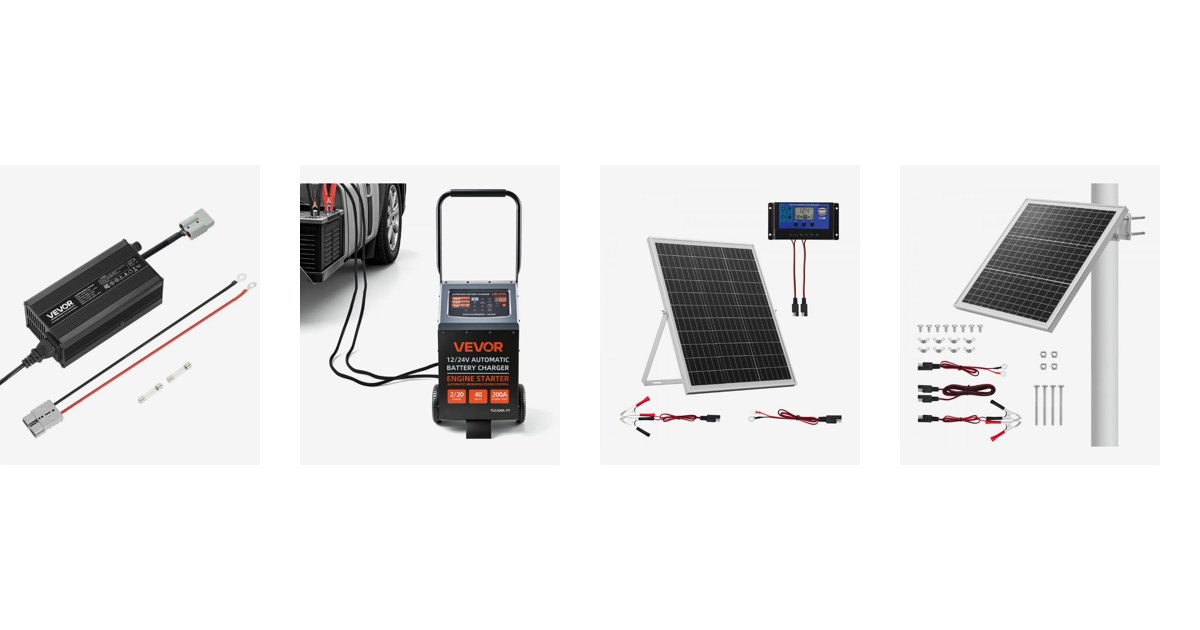
- UY240-HF1210, 12 V 10 A (49,90 €): 14.6 V, 10 A, 146 W max output, 220–240 V input. Overheat, reverse polarity, short-circuit and overvoltage protection, a cooling fan, LED status lights, 0V activation, and a 1.4 ft (about 43 cm) 50 A Anderson-to-M8 terminal cable. Fine for 50–100 Ah batteries if overnight charging is OK.
- UY360-HF1220, 12 V 20 A (76,90 €): our pick for a 12 V lithium battery. Same features, twice the current (20 A, 292 W) for 27,00 € more (our arithmetic); VEVOR rates it at 5 hours for 100 Ah.
- UY600-HF2420, 24 V 20 A (91,90 €): for 24 V (25.6 V) LiFePO4 banks: 29.2 V, 20 A, 584 W, with an Anderson connector and M8 terminal adapter cable. 15,00 € more than the 12 V 20 A model (our arithmetic). Its listing is thinner and contradicts itself on the charging curve (“4-stage” in the summary, “three-stage” in the description).
Wheeled 12/24 V chargers with engine start (142–213 €)
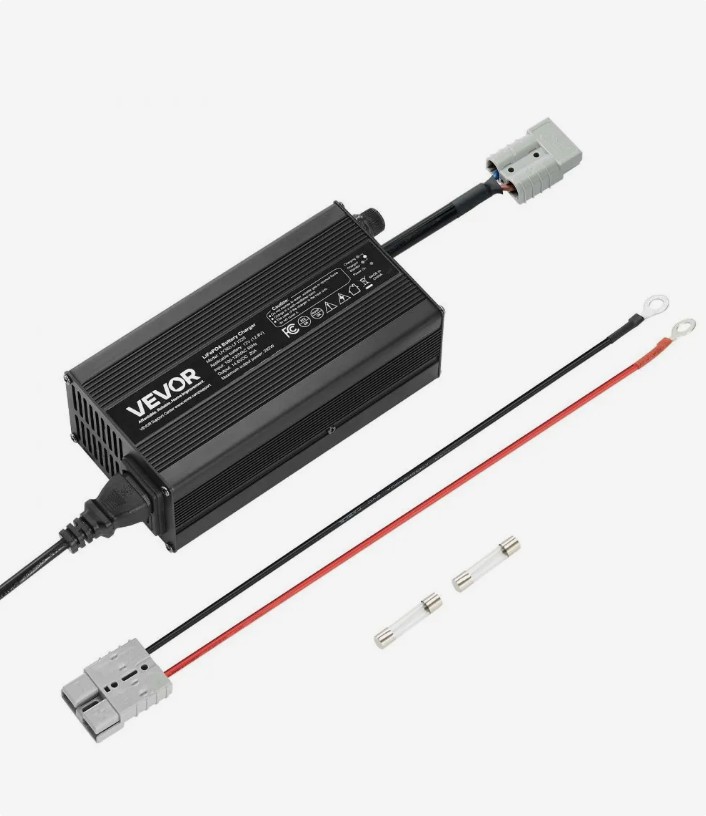
These are mains-powered (230 V, 50 Hz) workshop chargers on wheels with a folding handle and 1.8 m battery cables. They detect 12 V or 24 V automatically, use what VEVOR calls a 9-stage lead-acid charging algorithm, and add an engine start boost for a dead battery. Unlike a portable jump starter they need a socket, so they belong in a garage, a farm shed or a small fleet yard.
- HFWH25150DV-EU, 150 A (141,99 €): 25 A charging at 12 V, 12 A at 24 V, 150 A engine start at 12 V. Note the spec line “No Engine Start Function (24V)”: it charges 24 V trucks but will not start them.
- TS2260A-PT, 200 A / 100 A (188,99 €): 2 / 20 / 40 A at 12 V, 2 / 20 A at 24 V, and engine start at both voltages (200 A at 12 V, 100 A at 24 V). The low 2 A setting suits motorbike and small batteries. 47,00 € more than the 150 A model (our arithmetic).
- TS0560A-PT, 250 A / 125 A (212,99 €): 5 / 30 / 60 A at 12 V, 5 / 30 A at 24 V, 250 A / 125 A engine start. Only 24,00 € more than the 200 A model (our arithmetic) for the fastest charging here; the one to buy if you service trucks or tractors.
One caution: on November 2, 2026 the three listings shared a single customer review, 2 out of 5, saying the charger “works, kinda” and that its repair and desulfation modes were unclear; VEVOR replied by pointing to the manual on the product page. One review is not a verdict, but there is little real-world feedback on these yet.
Solar trickle chargers (31–56 €)
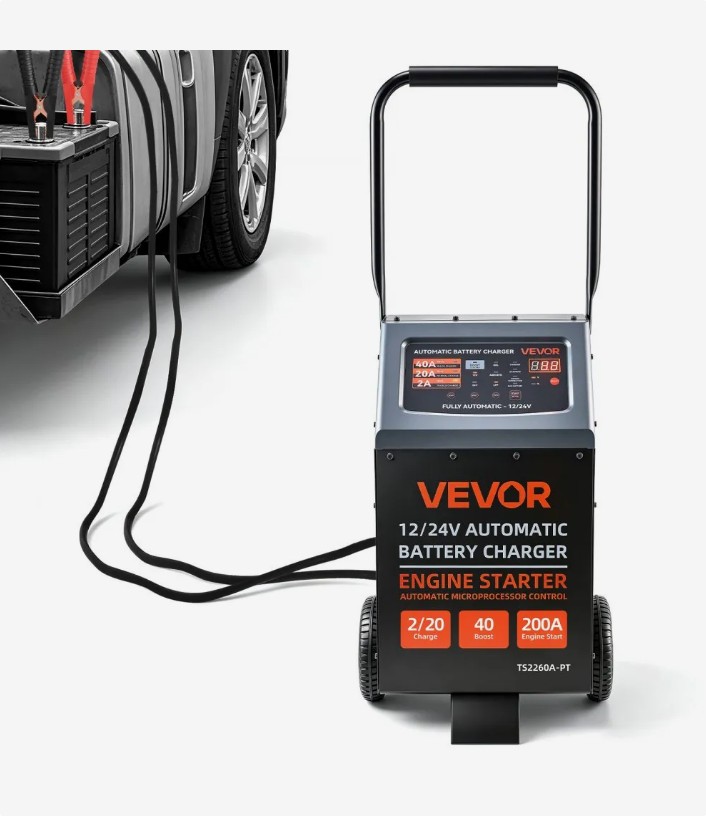
A small panel and a charge controller that keep a 12 V battery topped up wherever there is daylight: a car or camper parked for weeks, a boat on its mooring, a tractor, a gate opener or an electric fence. All six are 12 V and monocrystalline.
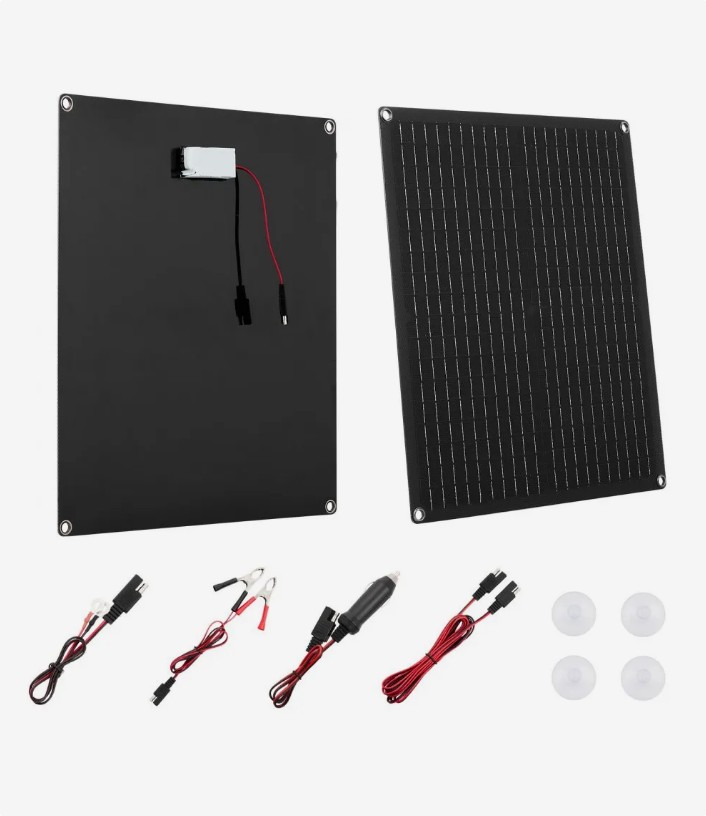
- 30 W flexible ETFE panel (30,90 €): the cheapest charger here and the lightest (0.64 kg, 460 × 395 mm), with a built-in controller, IP67, and the most cables: alligator clips, O-ring terminals and a cigarette-lighter plug (each 1.1 m) plus a 3.1 m extension. Ideal on a dashboard or a boat cover; VEVOR says not to use it while the vehicle is moving.
- 25 W glass panel, MPPT (32,90 €): tempered glass, an external MPPT controller, IP67, a 0–60° bracket, clips, O-ring terminals and a 122-inch (about 3.1 m) extension. 1.77 kg. Our pick for most people: it costs 3,00 € less than the 20 W version of the same kit (our arithmetic).
- 20 W glass panel, MPPT (35,90 €): the same kit with a smaller 373 × 370 mm panel. Only worth it if space is that tight.
- 30 W glass panel, MPPT (35,90 €): the same price as the 20 W kit (our arithmetic) for 30 W; IP65, 2.09 kg, clips (no O-ring terminals listed) and the bracket. VEVOR’s Q&A confirms the MPPT controller is included and rates it at 20 A.
- 50 W glass panel, MPPT (55,90 €): the biggest panel, for bigger batteries or cloudy winters: IP65, a 0–60° bracket with M6 screws and pre-drilled holes for a wall, deck or roof, 3.7 kg. 20,00 € more than the 30 W glass kit (our arithmetic).
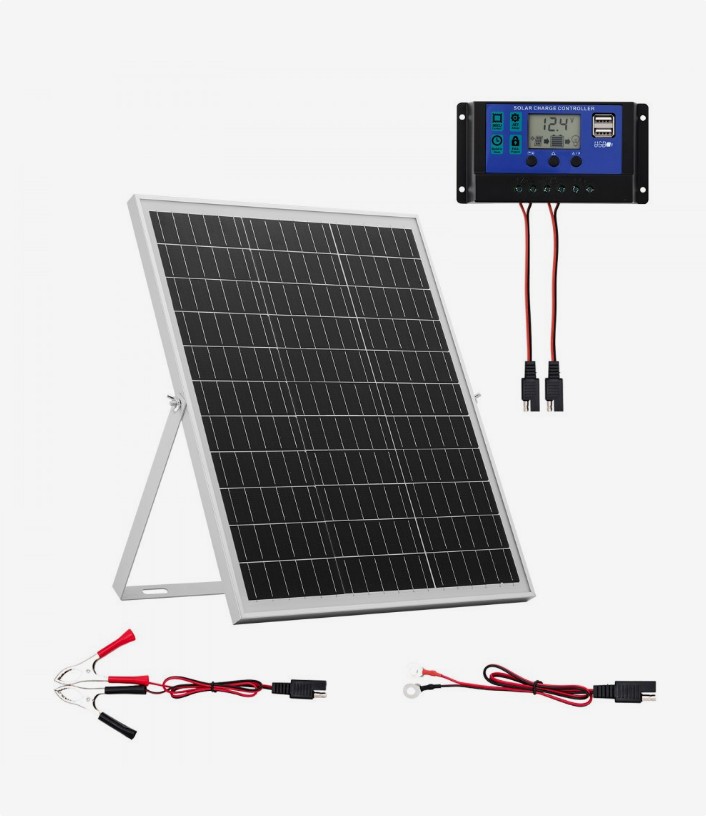
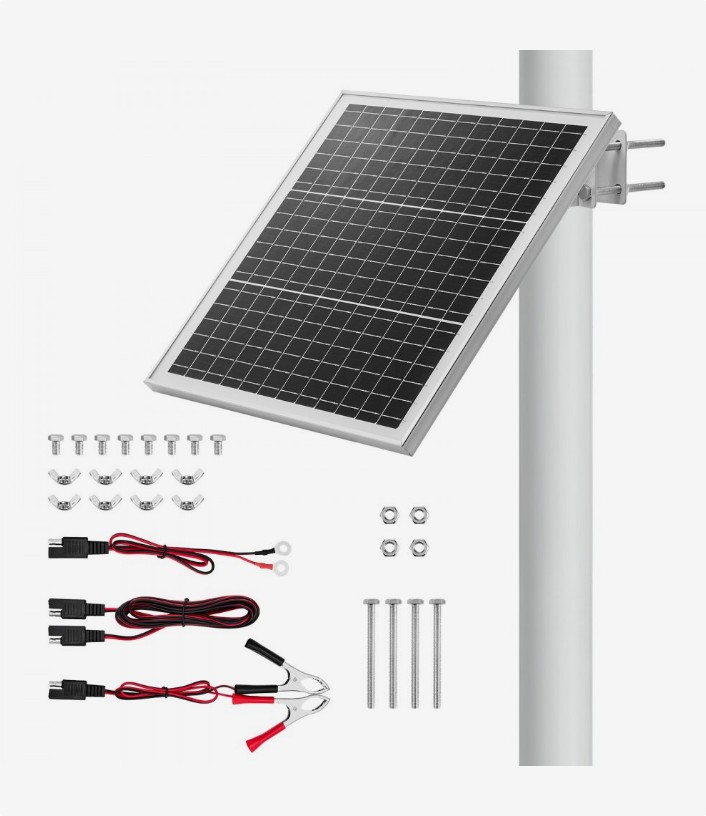
- 20 W pole-mount panel (53,99 €): made for gate openers, electric fences, garden lights, farm gear and cameras, with the controller built in and a 0–60° bracket for 40–80 mm poles; IP67, 3 kg. It costs 18,09 € more than the 20 W MPPT kit (our arithmetic); pay that only if you need the pole mount.
A quirk in the listings: the four MPPT kits say the controller “automatically stops charging once the battery reaches 12V and resumes when the voltage drops”. A full 12 V battery sits well above 12 V, so read that as marketing shorthand and check the controller’s settings and the manual for your battery type after delivery.
Price steps worth knowing
All differences are our arithmetic from the prices above:
- LiFePO4 10 A to 20 A: +27,00 €. 12 V 20 A to 24 V 20 A: +15,00 €.
- Wheeled 150 A to 200 A: +47,00 € (and you gain 24 V engine start). 200 A to 250 A: +24,00 €.
- Solar MPPT kits: the 25 W is 3,00 € cheaper than the 20 W; the 30 W costs the same as the 20 W; 50 W is +20,00 € over 30 W.
What we left out
Two 20 W solar kits marked “Clearance”, a 36 V lithium charger that was out of stock, and a flat-roof 50 W kit with only one left on November 2, 2026. We also skipped higher-current lithium chargers that were only listed on VEVOR’s US store, DC-to-DC chargers (they charge a leisure battery from the alternator, a different job) and portable jump starters, which our tire inflator guide covers.
Who each one is for
- Car parked for weeks outdoors this winter: 25 W MPPT solar kit (32,90 €), or the 30 W flexible panel (30,90 €) behind the windscreen.
- Camper or boat with a 12 V LiFePO4 battery: 12 V 20 A LiFePO4 charger (76,90 €).
- 24 V lithium solar bank: 24 V 20 A LiFePO4 charger (91,90 €).
- Home garage, cars and motorbikes: TS2260A-PT (188,99 €), with its low 2 A setting.
- Farm or fleet with trucks and tractors: TS0560A-PT (212,99 €).
- Gate opener or electric fence: 20 W pole-mount kit (53,99 €).
Related on SiftGuide
Running 230 V gear from the battery you just charged? See our VEVOR power inverter guide. For tyres and jump starters: the VEVOR tire inflator buying guide. Keeping food cold off-grid: the VEVOR car fridge buying guide. And for charging a battery bank from the wind: the VEVOR wind turbine buying guide.
FAQ
Can I charge a lead-acid car battery with a LiFePO4 charger?
No. VEVOR says its lithium chargers are “Not suitable for lead-acid batteries”. For a lead-acid car battery use one of the wheeled chargers or a solar trickle charger.
How long does a 20 A charger take?
About 5 hours for a 100 Ah battery from empty, as VEVOR claims for the 20 A lithium chargers, or about 3 hours for a typical 60 Ah car battery (our arithmetic). A partly charged battery takes less.
Can a solar trickle charger recharge a flat battery?
Only slowly. A 25 W panel gives at most about 2 A in full sun (our arithmetic) and much less in winter. Use it to keep a healthy battery topped up; recharge a flat one with a mains charger first.
Do the solar kits need a separate controller?
No. The 20, 25, 30 and 50 W glass kits come with an external MPPT controller (VEVOR’s Q&A confirms it for the 30 W), and the flexible 30 W and the pole-mount 20 W have the controller built in.
Is a wheeled charger with engine start the same as a jump starter?
No. It boosts the engine from mains power, so it only works near a 230 V socket. A portable jump starter has its own battery and works at the roadside.
Is shipping free to Romania?
Yes, on all 12 models we link: each showed free shipping to Romania on November 2, 2026.
Sources: VEVOR EU product pages, spec lists, reviews and Q&A answers for the models above (UY240-HF1210, UY360-HF1220, UY600-HF2420, HFWH25150DV-EU, TS2260A-PT, TS0560A-PT and six 20–50 W solar trickle chargers), VEVOR EU car battery charger, battery charger, wheel charger and solar trickle charger category pages, and VEVOR EU return policy (“All our products come with a 12-months warranty and can be returned for free within 30 days of delivery for approved reasons!”); all checked on November 2, 2026. Prices in euros, VAT included, as shown with Romania as the delivery country.