Affiliate disclosure: this post contains an affiliate link to ElevenLabs (via PartnerStack). If you subscribe through it, SiftGuide may earn a commission at no extra cost to you; it does not change your price. Every step, limit and recommendation below comes from ElevenLabs’ official documentation and pricing page, checked on October 18, 2026. Prices are in US dollars and exclude taxes. We have not run a long-term test of both cloning methods ourselves.
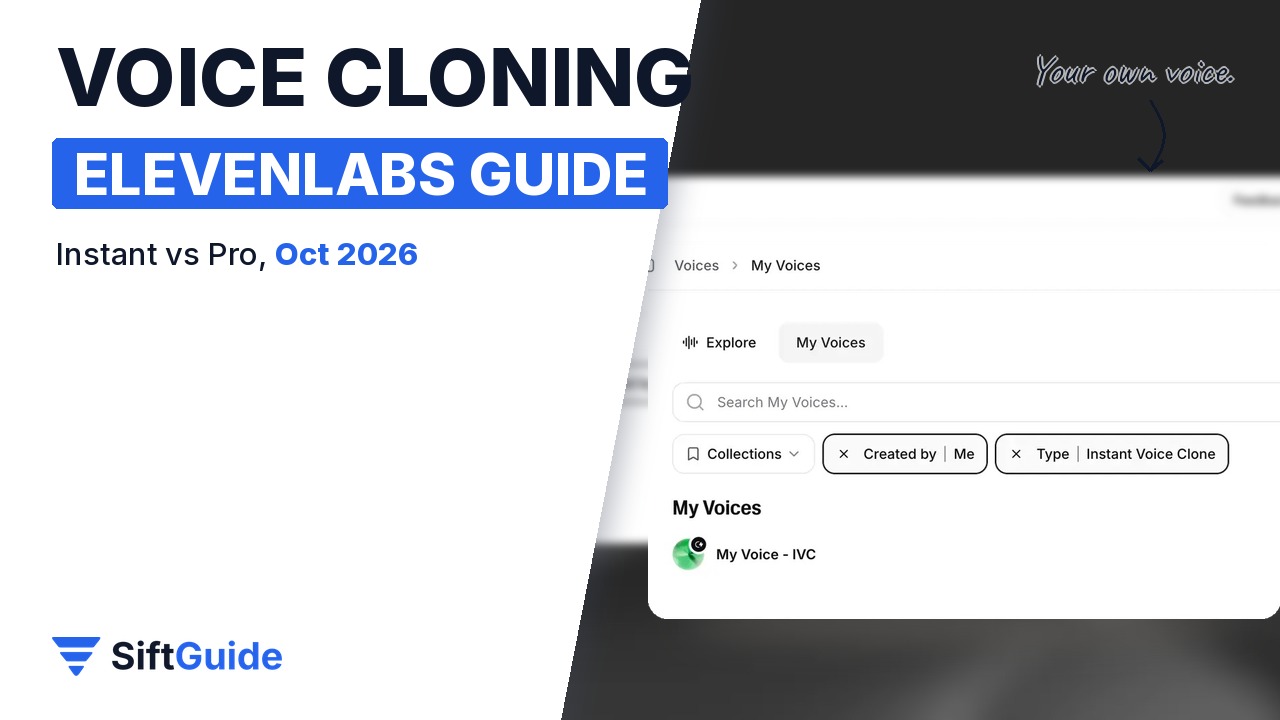
ElevenLabs can turn a recording of your voice into a voice you can type into: you write the script, and the clone reads it in your voice. There are two ways to do it, and they are not just a fast and a slow version of the same thing. Instant Voice Cloning (IVC) works from a minute or two of audio and is ready straight away. Professional Voice Cloning (PVC) trains a dedicated model on at least 30 minutes of your voice and takes hours, but sounds closer to you. This guide covers which plan you need, how to record, and the exact steps for both.
Instant vs Professional Voice Cloning at a glance
Method: Instant Voice Cloning
- Plan you need: Starter (US$6/month) and up
- Audio to upload: About 1–2 minutes of clean audio (more than 3 minutes adds little)
- Ready in: Straight away, no training
- Whose voice: A voice you have the right and consent to clone (you confirm this when saving)
Method: Professional Voice Cloning
- Plan you need: Creator (US$22/month) and up
- Audio to upload: At least 30 minutes; ElevenLabs recommends 1–3 hours
- Ready in: Fine-tuning usually 3–6 hours, up to 24 hours
- Whose voice: Only your own voice, confirmed by a voice verification step
ElevenLabs’ own summary: IVC uses your audio as a live reference at generation time, so its quality is capped by that recording and it can drift when you ask for a very different style (a voice cloned from calm narration may sound different when asked to express strong emotion). PVC fine-tunes the model on your recordings, so it is more consistent across speaking styles and handles emotional range better. For most production work where the voice represents you or a brand, ElevenLabs recommends PVC; IVC is the practical starting point.
See ElevenLabs plans with voice cloning
Before you start: record audio the clone can learn from
Both methods copy everything they hear: your speed, accent, breathing and mouth clicks, but also room echo, background noise and music. ElevenLabs’ recording advice, condensed:
- Quality beats length. For IVC, about 1–2 minutes of clear audio with no reverb or background noise; the number of files doesn’t matter, only the total runtime. Going past 3 minutes yields little improvement and can even make the clone worse.
- One speaker only, at a consistent volume and tone, without long silences.
- Perform the way you want it to sound. If you read slowly and flatly, the clone will be slow and flat; if you read fast and with emotion, it copies that. Keep one style across all samples (for an audiobook voice, record yourself reading a book).
- Level: ElevenLabs gives an ideal of -23 dB to -18 dB RMS with a true peak of -3 dB.
- File format: MP3 at 192 kbps or higher is recommended. WAV and other uncompressed formats usually don’t improve the clone and can cause upload problems.
- Language: record in the language you’ll mostly generate. The text decides the language, but the accent comes from the voice, so an English-recorded clone speaking Spanish will very likely have an English accent.
For PVC, ElevenLabs goes further: any microphone works, but it suggests an XLR mic into an audio interface (it names an Audio Technica AT2020 or Rode NT1 into a Focusrite as low-end options), a pop filter, about two fists from the mic, and a quiet room; a thick duvet or quilt can dampen a temporary recording space.
How to make an Instant Voice Clone (Starter plan and up)
- In the ElevenLabs dashboard, open Voices in the left menu and click the plus icon.
- Choose Instant Voice Clone.
- Upload your audio, or record it in the browser, following the on-screen instructions.
- Name and label the clone, confirm that you have the right and consent to clone the voice, and click Save voice.
- Go to Voices > My Voices and click Use voice. The clone is available immediately; there is no training wait.
If the result doesn’t sound like you, change the samples rather than the settings: ElevenLabs says you can’t change a clone’s accent or tone after it’s created, and small changes to the audio can make a large difference. IVC may struggle with uncommon accents or very distinctive voices; that is the main reason to step up to PVC.
How to make a Professional Voice Clone (Creator plan and up)
- In Voices, click Create Voice and choose Professional Voice Clone.
- Click Upload samples, or pick Record yourself to record in the browser; ElevenLabs provides sample scripts for narrative, conversational and advertising styles, or you can use your own. Spoken voice only: PVC doesn’t support singing.
- Check the length feedback. ElevenLabs recommends at least an hour of training audio, ideally close to three hours (30 minutes is the bare minimum). For several hours, split the audio into roughly 30-minute files so it uploads more easily.
- Optionally clean each clip with Audio settings: remove background noise, or separate speakers if a clip has more than one.
- Verify your voice. Use the same or similar equipment and delivery as in your samples. If verification fails, wait 24 hours and try again, or contact support.
- Wait for fine-tuning. Usually 3–6 hours, but it depends on the queue and can take up to 24 hours. You can watch the status in My Voices and you get an in-app and email notification when it’s ready. Trying to use it before then gives the error “No model found for this voice”.
- In Voices, open the Personal tab and click Use next to your clone.
Every PVC is trained automatically on the Flash v2.5, Turbo v2.5 and Multilingual v2 models (English-trained voices also on Flash v2 and Turbo v2), and ElevenLabs flags new models you can fine-tune on later from My Voices.
Cloning a voice through the API
Developers can create an Instant Voice Clone with ElevenLabs’ Python SDK. This is the example from ElevenLabs’ IVC quickstart (it assumes you have already set up your API key and SDK); it prints the new voice ID, which you then pass to text to speech:
# example.py
import os
from dotenv import load_dotenv
from elevenlabs.client import ElevenLabs
from io import BytesIO

load_dotenv()

elevenlabs = ElevenLabs(
  api_key=os.getenv("ELEVENLABS_API_KEY"),
)

voice = elevenlabs.voices.ivc.create(
    name="My Voice Clone",
    # Replace with the paths to your audio files.
    # The more files you add, the better the clone will be.
    files=[BytesIO(open("/path/to/your/audio/file.mp3", "rb").read())]
)

print(voice.voice_id)
Clones can’t be downloaded as files, but they can be used outside ElevenLabs’ website: any service you give your API key to can generate speech with the voices in your account.
Which ElevenLabs plan do you need for voice cloning?
- Free: no cloning listed (Instant Voice Cloning starts on Starter).
- Starter, US$6 a month (30,000 credits): commercial license plus Instant Voice Cloning. ElevenLabs’ help center gives Starter as allowing 10 cloned voices. No Professional Voice Clone slots.
- Creator, US$22 a month (121,000 credits): adds Professional Voice Cloning with 1 PVC slot. This is the cheapest way to get a clone that is trained on your voice.
- Pro, US$99 a month: also 1 PVC slot, with 600,000 credits for heavy or API use.
- Scale and Business: 3 and 10 Professional Voice Clones respectively, for teams.
You can earn extra PVC slots when a voice you shared to the Voice Library is marked Studio Quality. If you downgrade below Creator, your PVC stays in the account but can’t be used until you upgrade again. Prices exclude taxes; for credits, rollover and annual billing see our ElevenLabs pricing guide.
Start with ElevenLabs (free plan available)
Rules worth knowing before you clone
- Consent: for IVC you confirm you have the right and consent to clone the voice. A PVC can only be of your own voice; even with someone’s consent you can’t make a PVC of them. They can make and verify their own PVC and share it with you privately via a sharing link.
- Traceability: ElevenLabs says all audio generated by its models can be traced back to the user who generated it, and its Terms of Service and Prohibited Use Policy apply.
- Keep your originals: you can’t export a clone, and re-cloning from the same audio gives a slightly different voice each time, so store the samples you used.
Making videos with your new voice? See our guides to Filmora plans and DemoCreator plans for the editing side.
Want your videos in other languages too? ElevenLabs Dubbing translates a whole video and recreates each speaker’s voice in the new language. See our ElevenLabs Dubbing guide.
Want to narrate a whole book in your cloned voice? See our ElevenLabs audiobook guide for the Audiobooks workflow, credits per book, and the voice-verification step Spotify exports need.
FAQ
Can I clone my voice on ElevenLabs for free?
No. Instant Voice Cloning is listed from the Starter plan (US$6 a month before taxes) and Professional Voice Cloning from Creator (US$22 a month).
How much audio do I need to clone my voice?
About 1–2 minutes of clean audio for an Instant Voice Clone (more than 3 minutes adds little), and at least 30 minutes, ideally 1–3 hours, for a Professional Voice Clone.
How long does a Professional Voice Clone take?
Fine-tuning usually takes 3–6 hours after you verify your voice, depending on the queue, and can take up to 24 hours. An Instant Voice Clone is ready straight away.
Can I clone someone else’s voice?
For an Instant Voice Clone you must confirm you have the right and consent to clone the voice. A Professional Voice Clone can only be of your own voice, even if the other person consents; they can create their own and share it with you.
Can my cloned voice speak other languages?
Yes, any language supported by Flash v2.5 and Multilingual v2. The language follows the text you write, but the accent comes from the recording, so clone in the language you’ll use most.
Can I download my voice clone?
No. Clones stay in your ElevenLabs account, though you can use them in other apps through the ElevenLabs API with your API key.
Sources
All checked on October 18, 2026.
- ElevenLabs docs – Instant Voice Cloning
- ElevenLabs docs – Professional Voice Cloning
- ElevenLabs docs – Voice cloning: how it works
- ElevenLabs docs – Instant Voice Cloning quickstart (API)
- ElevenLabs Help Center – Voice Cloning FAQ
- ElevenLabs Help Center – What happens to my cloned voices when I downgrade?
- ElevenLabs – Pricing: https://elevenlabs.io/pricing